

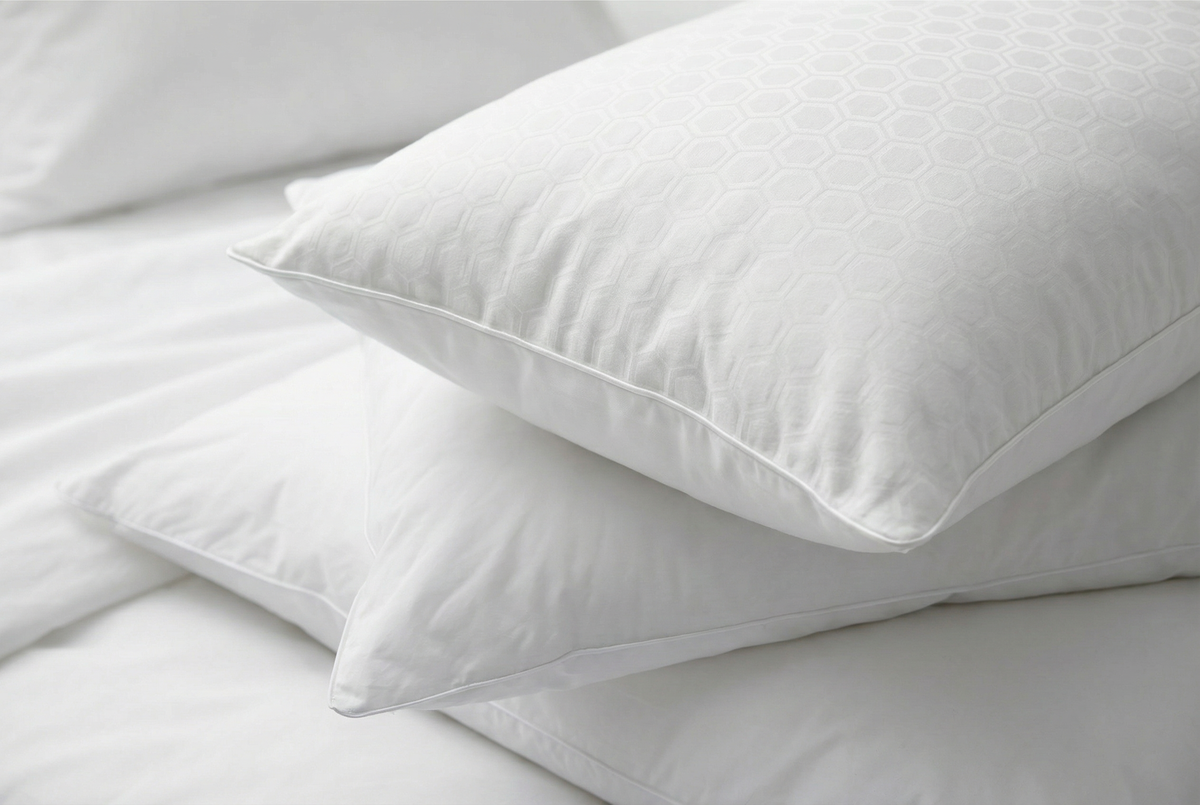
Mornings should not start with stretching a stiff neck or searching for the position in which your body finally relaxes. That is why the question of how to choose a pillow for sleeping matters more than choosing yet another decorative accessory for the bedroom. The right pillow keeps your head and cervical spine in their natural alignment. It does not draw attention to itself - it simply lets you fall asleep calmly and wake up rested.
A pillow is not one-size-fits-all. What feels pleasantly soft to one person may leave another's head too low. So when choosing, do not start with the colour of the pillowcase or with what you are used to. Pay attention to your sleeping position, the width of your shoulders, the sensitivity of your neck and whether you prefer to sink in gently or have stable support.
Start with the position you actually sleep in
Most people do not fall asleep and wake up in the same position. Even so, there is usually one in which you spend the most time. It determines the ideal height and firmness of your pillow more than anything else.
Side sleeping needs height
When you sleep on your side, the pillow should fill the space between the mattress and your head. Your shoulder creates a gap that a pillow that is too low cannot support. Your head then drops to the side and your neck may protest with unpleasant tension in the morning.
Side sleepers usually do best with a medium to high pillow with a sufficiently stable filling. If you have broader shoulders or sleep on a firmer mattress, you will generally need more volume. A soft mattress, on the other hand, lets the shoulder sink deeper, so a lower option may work too.
Back sleeping requires a fine balance
When you sleep on your back, your head should not be tilted forwards or backwards. A pillow that is too high pushes your chin towards your chest, while one that is too low leaves your neck without the support it needs. A medium-height pillow that supports the natural curve of the neck without lifting the head too high is usually ideal.
Look for a feeling of calm stability. When you lie down, your shoulders stay on the mattress, your neck is relaxed and your face points naturally upwards. It is not about lying perfectly still, but about giving your body a starting position from which it can rest well.
Stomach sleeping calls for as little height as possible
Sleeping on your stomach often strains the cervical spine, as your head stays turned to the side. If this is your natural and comfortable position, choose a very low, soft and yielding pillow. Some people are happy sleeping without one, or with a pillow only partly under the shoulder and chest.
A high, firm filling usually makes things worse here. The higher your head, the more rotation your neck has to endure. So do not insist on choosing a voluminous pillow just because it looks luxurious.
How to choose a pillow by height and firmness
Height and firmness are related, but they are not the same thing. A tall soft pillow compresses significantly once you lie down. A low firm pillow, on the other hand, can hold your head higher than you would expect. What matters is its height under load - that is, when you are actually lying on it.
You will appreciate a soft pillow if you like a light, enveloping feel and often change position during the night. It provides less precisely defined support but adapts easily. Medium firmness is a safe choice for many people, especially when alternating between back and side sleeping. A firmer pillow tends to suit those who need more stable support or have broader shoulders.
Do not be guided only by how the pillow looks on the bed. A fluffy look does not necessarily mean a lot of volume during sleep, and a compact shape does not have to be uncomfortable. Prefer a material and construction that keep their character even after several hours of use.
The filling material determines the feel and everyday care
Every filling works differently. Some pillows feel airy and soft, others provide more precise support, and others score points for easy care. There is no single best material - only the one that matches your needs and habits.
Feather and down fillings are popular for their light, soft and naturally fluffy character. The pillow can be plumped up and adjusted in a moment. It is beautifully comfortable for those who are not looking for a fixed shape, but it requires regular care and may not suit people sensitive to natural fillings.
Hollow fibre and modern synthetic fillings can offer pleasant softness, good breathability and more practical washing. They are suitable for households where easy care, more frequent washing or managing allergies matter. Quality varies considerably here - a good synthetic filling should stay springy, not clump together and not feel plasticky.
Memory foam provides more pronounced shape support and may suit people who sleep mostly in one position. It is often part of anatomically shaped pillows. Its properties may not suit everyone, though: the feel is more compact and some versions are less airy. If you often turn over at night or love a classically soft bed, you may find it too firm.
Cooling fillings or materials with better air circulation have their place especially in a warm bedroom and during summer. If you wake up hot at night, do not underestimate the pillowcase and pillow protector either. Breathable cotton or a smooth, light material can change how a pillow feels just as much as the filling itself.
Pay attention to your mattress, shoulders and your body's small signals
A pillow always works in tandem with the mattress. On a soft mattress the body sinks deeper, on a firmer one it stays higher. The same pillow can therefore be ideal in one bed and too high in another. When furnishing a bedroom, it makes sense to consider both layers together.
Your build matters too. Broader shoulders, a longer neck or a more pronounced curve of the spine can shift your choice towards a different height than a general chart recommends. Treat recommendations as a guide, not as a rule that must work for everyone.
Your body usually tells you quickly. If you feel stiffness in your neck, pressure between your shoulder blades, a headache or tingling in your shoulders in the morning, the pillow may not be the only cause. But it may be one of the first places worth looking for a change. Likewise, take note if you fold your pillow in half during the night, slip your hand under it or keep pushing it aside. This is often an intuitive way of making up for missing height or support.
Size is not just a question of bedding
In Czech bedrooms, 70 × 90 cm is a common size, but you do not need to use its whole surface for sleeping. Smaller sizes can be more practical, especially if you want your head to stay in the part of the pillow with consistent support. A larger pillow, on the other hand, offers a generous, hotel-like feel and plenty of room for changing position.
Also choose the size according to how your bed looks and what bedding you have. Comfort and aesthetics do not have to be mutually exclusive. On the contrary, a well-made bedroom where the materials feel light and pleasant naturally invites you to unwind in the evening. Lejaan is built on the idea that thoughtfully made textiles are not mere furnishings, but part of everyday rest.
Give your pillow proper care and replace it in time
Even a quality pillow has a limited lifespan. The filling gradually loses its springiness and absorbs moisture and everyday dirt. Air it regularly, wash it according to the manufacturer's instructions and use a protective cover to keep it fresh for longer. Change your pillowcase often, ideally together with your bed linen.
Replace it when the pillow stays flat even after plumping, loses its shape or no longer gives you the same feeling of support as before. This is not a trivial detail. You spend several hours on it every night, and its condition is reflected in how you feel in the morning.
Choose a pillow on which your shoulders relax, your breathing calms and your head does not have to search for a better spot. Such comfort is not ostentatious. It is quiet, precise and reminds you every evening that a good day often begins the night before.
Share:
Premium Bed Linen for Calmer Mornings
How to Choose Summer Bedding for Calm Sleep